 Save
Oregano does contain compounds that show antimicrobial activity in laboratory research, but that is not the same as proving that oregano tea, capsules, or essential oil can solve a personal health problem. The strongest evidence is about concentrated extracts and essential oils tested under controlled conditions, not a spoonful of dried oregano in a home kitchen. A careful reading of the research points to three practical conclusions: oregano is useful as a culinary herb, oregano oil is a concentrated product with real safety considerations, and bold social media claims usually leap far beyond what the evidence can support.
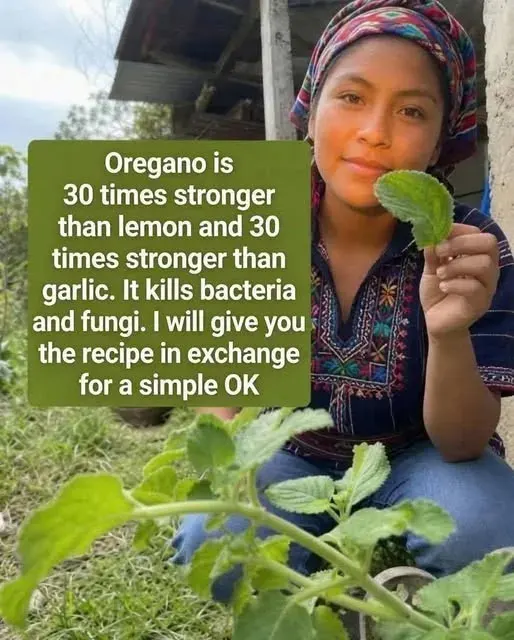
Which “oregano” does the photograph show?
The thick, broad, scalloped leaves in the image resemble Cuban oregano, rather than the smaller-leaved culinary oregano commonly called Origanum vulgare. NC State Extension describes Cuban or Caribbean oregano as Plectranthus amboinicus, also classified as Coleus amboinicus. This remains a visual comparison, not a confirmed identification. Research on one plant or essential oil cannot automatically be transferred to another plant sharing a common name. The “30 times stronger” comparison in the image supplies no test method or clinical evidence.
Why Oregano Gets Attached to Big Claims
Oregano sits at the crossroads of food tradition and plant chemistry. It belongs to a group of aromatic herbs used in Mediterranean, Middle Eastern, and Latin American cooking, and its fragrance comes from volatile compounds that plants produce in tiny amounts. When researchers study oregano, they often focus on essential oil, which is a concentrated extract, rather than on the fresh or dried leaves sprinkled into food. That distinction matters. A flavorful herb in a sauce, a home-brewed infusion, a capsule, and a laboratory essential oil sample are not interchangeable products.
A review indexed by the U.S. National Library of Medicine notes that Origanum vulgare contains both volatile essential-oil compounds and nonvolatile phenolic compounds, with carvacrol and thymol often highlighted in essential oil research https://pubmed.ncbi.nlm.nih.gov/34567161/. That helps explain why oregano becomes a tempting subject for dramatic online posts: the plant has real chemistry, and some of that chemistry is biologically active in controlled studies. The problem begins when a lab observation is converted into a household promise without explaining concentration, exposure, product quality, or human evidence.
Use this simple filter when you see an oregano claim online:
- Form: Is the claim about dried leaves, tea, oil of oregano, or essential oil?
- Setting: Was the evidence from a test tube, food-packaging experiment, animal model, or human study?
- Outcome: Is the claim about measured microbial growth, general wellness, or a specific personal health result?
- Safety: Does the post explain concentration, product quality, skin contact, swallowing, and who should ask a professional first?
- Source: Does it cite an actual paper or authority, or only a dramatic caption?
What Laboratory Studies Can Actually Show
Laboratory studies are valuable because they let scientists control conditions. Researchers can expose specific microbes to measured amounts of oregano essential oil, carvacrol, thymol, or other compounds, then compare growth patterns. That can reveal whether a substance has antimicrobial activity under those exact conditions. It does not answer the broader question many readers care about: what happens when a person eats oregano, drinks an infusion, or uses a commercial supplement.
Reviews of oregano essential oil often report activity against bacteria and fungi in controlled settings. A 2025 systematic review on Origanum essential oil and antifungal activity found that oregano species and their oils have been studied against fungi such as Candida, Aspergillus, and Penicillium, with carvacrol and thymol among the key compounds discussed https://pubmed.ncbi.nlm.nih.gov/39948037/. The review supports the idea that these plant oils are scientifically interesting. It does not turn a home preparation into a verified clinical product.
Essential Oil Is Not the Same as Kitchen Oregano
The difference between essential oil and dried oregano is a little like the difference between vanilla extract and a vanilla-scented cake: the aromatic compounds may be related, but the amount and context are very different. Essential oils are highly concentrated mixtures of volatile compounds. Fresh oregano leaves and dried oregano flakes contain those compounds in a food matrix, alongside fiber, water or dried plant material, and many other components. A cup of oregano tea may smell strong, but it is still not the same as a standardized essential oil tested in a lab.
Cleveland Clinic’s consumer health guidance makes a similar distinction between oregano used in food, oregano tea, oil of oregano, and oregano essential oil, and it specifically cautions that essential oil is concentrated and should not be swallowed https://health.clevelandclinic.org/oregano-benefits. For everyday cooking, oregano is best understood as a seasoning that adds aroma and flavor. For concentrated products, the question becomes less about pantry creativity and more about product quality, exposure, and individual suitability.
Why Social Media Claims Often Overstate the Point
Viral ingredient posts often compress several ideas into one catchy statement: a real plant compound, a lab finding, a traditional use, and a personal health promise. That compression is where accuracy gets lost. Oregano essential oil can show activity against microbes in research conditions, but a social post may imply that any oregano preparation will work the same way in the body. Those are different claims, and they need different evidence.
A careful article should also avoid ranking oregano against lemon, garlic, or any other ingredient as if food chemistry worked like a sports scoreboard. Strength depends on what is being measured: concentration of a compound, activity against a particular microbe, sensory intensity, food-preservation performance, or a human outcome. Even among oregano plants, compound levels can vary by species, growing conditions, harvest timing, and processing. That variability is one reason broad claims about a single household preparation are unreliable.
For more practice reading ingredient posts with a cool head, see How to Evaluate Viral Ingredient Health Claims. For a closely related discussion of oregano oil, see Oregano Oil Health Claims: What the Evidence Says. And for a focused look at microbe-related wording, see Oregano and Microbe Claims: What Evidence Shows.
How to Use Oregano Sensibly in the Kitchen
The most evidence-aligned way to use oregano at home is also the simplest: treat it as a culinary herb. Add dried oregano early in simmered sauces, soups, stews, beans, roasted vegetables, and marinades so its aroma has time to bloom. Add fresh oregano more gently because its flavor can turn assertive. Pair it with tomato, olive oil, lemon zest, grilled vegetables, beans, poultry, fish, or warm bread. These uses do not require a health promise to be worthwhile; they make food taste better.
Oregano can also be part of a broader kitchen-wellness mindset without exaggeration. Herbs can help home cooks build flavor with less reliance on heavy sauces or excess salt, and they make simple meals more satisfying. That is a practical culinary benefit, not a claim that oregano changes a health condition. The safest framing is modest: oregano is a flavorful plant food with studied compounds, and concentrated products are different from dinner ingredients.
What to Know About Supplements and Concentrated Products
Supplements and concentrated herbal products deserve a higher level of scrutiny than dried herbs in a spice jar. The U.S. Food and Drug Administration explains that dietary supplements are not approved for safety and effectiveness before marketing in the same way many consumers assume, and it advises people to be informed and talk with a doctor, pharmacist, or other healthcare professional before using them https://www.fda.gov/food/dietary-supplements/information-consumers-using-dietary-supplements. NCCIH also notes that evidence varies widely across supplements, products can differ from what was tested in studies, and “natural” does not automatically mean safe https://www.nccih.nih.gov/health/using-dietary-supplements-wisely.
That does not mean every oregano product is automatically a problem. It means the burden of proof should be higher when a product is concentrated, swallowed as a supplement, applied to the skin, or promoted with strong health language. A label, a testimonial, or a traditional-use story cannot replace careful evidence. NCCIH’s guidance on complementary approaches encourages consumers to consider the scientific evidence, product quality, possible side effects, and their own circumstances before making health decisions https://www.nccih.nih.gov/health/are-you-considering-a-complementary-health-approach.
A Better Way to Read Oregano Research
When you see a study about oregano, ask what exact material was studied. Was it Origanum vulgare, another oregano species, a commercial oil, purified carvacrol, purified thymol, or a home-style infusion? Then ask what model was used. A petri dish, food sample, animal model, and human study each answer a different question. Finally, look for the size and quality of the evidence. A single promising experiment is a starting point, not a settled conclusion.
It also helps to separate food-preservation research from personal health claims. Oregano essential oil has been studied as a possible food-related antimicrobial and antioxidant additive, including in a review focused on food products https://pubmed.ncbi.nlm.nih.gov/25763467/. Food systems are controlled environments: researchers can measure oil concentration, temperature, packaging, and microbial targets. A kitchen or a human body is much more variable. Evidence in one setting may inspire further research in another, but it does not automatically transfer.
Bottom Line
Oregano’s antimicrobial reputation is not made from thin air: the plant contains compounds, especially in essential oil, that researchers have studied against microbes in controlled settings. The careful conclusion, though, is modest. Enjoy oregano as a flavorful herb. Treat concentrated oregano products as a separate category that requires more caution. Be skeptical of posts that turn lab findings into personal promises, especially when they skip the form of oregano, the amount used, and the type of evidence. The best answer is neither panic nor hype. It is a clear distinction between culinary use, laboratory interest, and claims that still need stronger human evidence.
Wrap-Up
Oregano is a useful kitchen herb with compounds that have been studied for antimicrobial activity, especially in essential oils. The evidence is strongest in laboratory and food-science contexts, not as proof that home oregano preparations produce specific personal health outcomes. Use oregano freely for flavor, read concentrated-product claims carefully, and bring personal questions to a qualified professional.
Frequently Asked Questions
- → Does oregano have antimicrobial compounds?
Yes. Oregano contains compounds such as carvacrol and thymol that have been studied for antimicrobial activity, especially in essential oils. The important limit is that most of this evidence comes from controlled research settings, not ordinary servings of oregano in food.
- → Is dried oregano the same as oregano essential oil?
No. Dried oregano is a culinary herb made from plant leaves. Oregano essential oil is a concentrated extract of volatile compounds. Research on essential oil should not be read as evidence that a sprinkle of dried oregano or a cup of oregano tea has the same effect.
- → Can I use oregano in cooking without worrying about these claims?
For most cooking purposes, oregano is simply a flavorful herb. Use it in sauces, roasted vegetables, beans, soups, and marinades because it tastes good. Strong health claims about concentrated products are a separate issue from normal culinary use.
- → Why do oregano claims spread so easily online?
They often start with a real detail, such as oregano’s carvacrol and thymol content, then skip the limits of the evidence. A lab finding can sound more dramatic when the post leaves out product type, concentration, study setting, and whether the result was shown in people.
- → What should I check before trusting an oregano supplement claim?
Check whether the claim identifies the exact product, cites human evidence, explains safety considerations, and avoids guaranteed language. If the product is concentrated or promoted for personal health use, discuss your own situation with a qualified professional.
References
This content was developed and refined using reliable sources.
- https://pubmed.ncbi.nlm.nih.gov/34567161
- https://pubmed.ncbi.nlm.nih.gov/39948037
- https://health.clevelandclinic.org/oregano-benefits
- https://www.fda.gov/food/dietary-supplements/information-consumers-using-dietary-supplements
- https://www.nccih.nih.gov/health/using-dietary-supplements-wisely
- https://www.nccih.nih.gov/health/are-you-considering-a-complementary-health-approach
- https://pubmed.ncbi.nlm.nih.gov/25763467